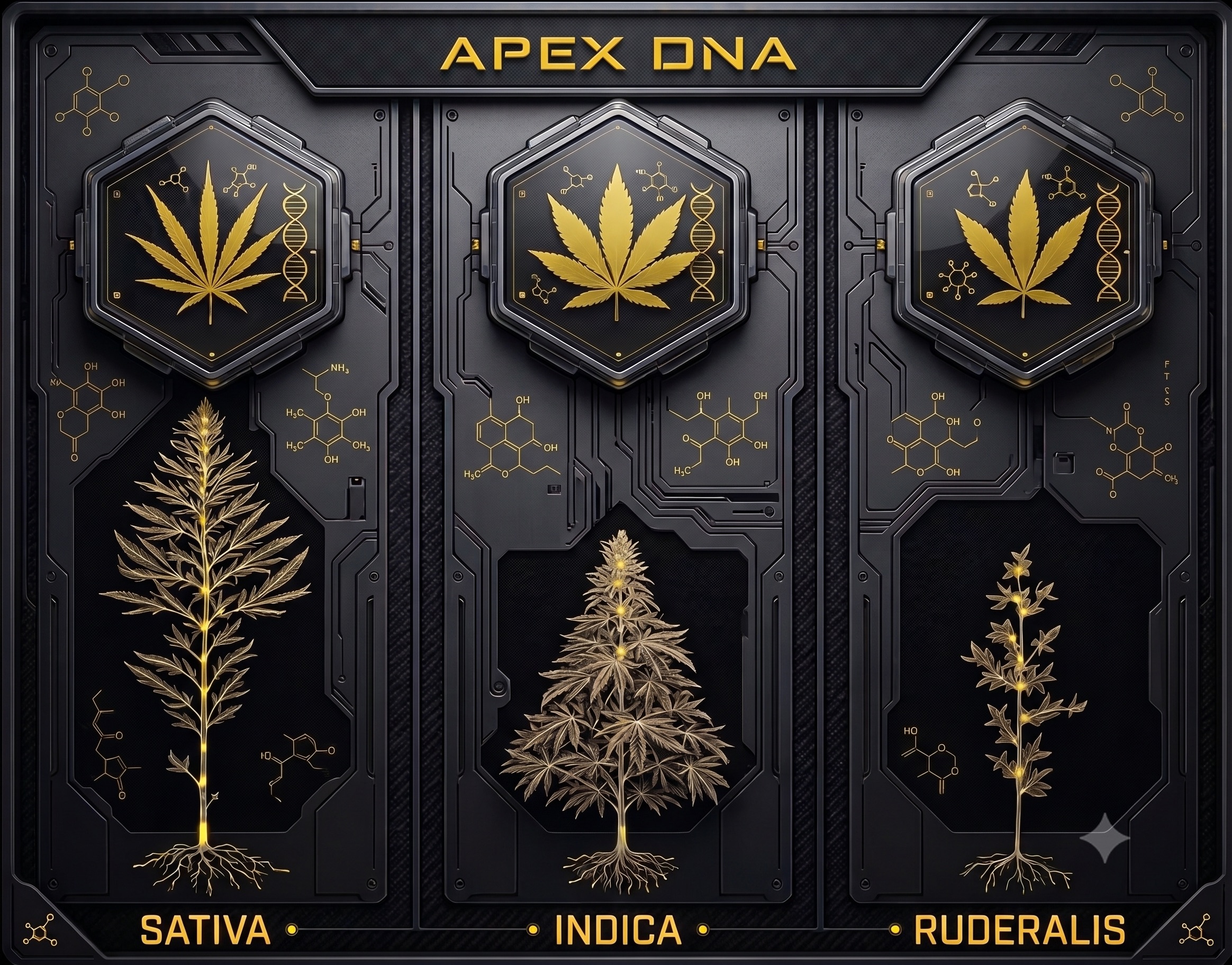
Few words in cannabis are used more often — or more loosely — than indica, sativa and ruderalis. They appear on every label and in every conversation, usually as a promise about how a plant will behave. Yet the terms began as something far more specific, and what they originally described has drifted a long way from how they are used today. This guide sets the record straight: where the names come from, what each one genuinely meant, why modern varieties have blurred them almost beyond usefulness, and why — for anyone who takes cannabis genetics seriously, as APEX DNA does with its documented Swiss heritage lines — a plant's lineage tells you far more than any two-word category.
Where the terms come from
The names are, first of all, botanical classifications — attempts to sort the plant by structure and geographic origin, not by effect. The framework dates to the 18th century: Carl Linnaeus described Cannabis sativa in 1753, and Jean-Baptiste Lamarck named Cannabis indica in 1785 to distinguish the plants he examined from India, which looked and grew differently. Cannabis ruderalis was described later still, for the wild-growing populations of Eastern Europe and Central Asia. From the beginning, then, these were labels for where a plant came from and how it grew — a record of adaptation, exactly like the landraces the terms originally described.
What each term actually described
Read as descriptions of origin and growth habit, the categories are genuinely informative:
- Sativa — the equatorial type. Long, consistent day length and long growing seasons favoured tall plants with narrow leaflets that flower slowly over many weeks. Classic examples trace to Thailand, Colombia, Mexico and Central Africa.
- Indica — the mountain type. In harsh, short-season regions such as the Hindu Kush of Afghanistan and Pakistan, the plants that survived were compact, broad-leaved, fast-flowering and heavily resinous — the foundation of traditional hashish cultures.
- Ruderalis — the northern type. Where summers are brief and unpredictable, populations adapted to flower by age rather than by day length, a survival strategy in latitudes where waiting for the light to change would leave no time to finish.
Every one of these traits — plant height, leaf shape, flowering time, resin production — is heritable, tuned by the environment and written into the population's genes. That is why the categories meant something concrete: they summarised a landrace's adaptation to a place.
Why the labels blur today
The problem is that almost nothing on a modern shelf is a pure sativa, indica or ruderalis. After decades of deliberate crossing, nearly every variety is a hybrid — a mosaic assembled from many ancestors. A plant's genotype (what it carries) no longer maps cleanly onto one of three tidy boxes, and its phenotype (what it actually expresses) is the product of that whole mixed inheritance interacting with how it was grown.
This is why the popular shorthand has largely broken down. Percentages like "70% indica" are estimates about ancestry, not measurements, and they say little about how a specific plant will actually present. Two plants sold under the same "indica-dominant" label can differ enormously, because the label describes a rough genetic average, not the individual. The category has become a marketing convenience rather than a reliable predictor.
The bigger myth: labels do not equal effect
The most common misuse is treating indica and sativa as a guide to how a plant will make someone feel — the familiar "indica relaxes, sativa energises" formula. Botanically, this was never what the terms meant; they described plant form and origin, not experience. What a plant expresses arises from its full chemistry — its cannabinoid ratios and its terpene profile — and those vary from individual to individual within any so-called indica or sativa. A two-word category simply cannot carry that information. (APEX DNA makes no claims about effects of any kind; the point here is strictly genetic literacy.)
Ruderalis and the auto-flowering trait
Of the three, ruderalis is the one whose importance is most often underestimated. On its own it is an unremarkable, low-yielding wild plant. But it carries one trait of enormous value to breeders: auto-flowering, the ability to flower by age regardless of light cycle. Crossed into photoperiod genetics, that single inherited trait is what made every auto-flowering variety possible. Ruderalis is the clearest example of why lineage matters more than category — its value lies not in what it is, but in the specific gene it contributes downstream.
A more useful modern framework: chemotypes
If indica and sativa no longer predict a plant's chemistry, what does? Increasingly, breeders and researchers describe cannabis by chemotype — its measured cannabinoid profile — rather than by leaf shape. The common scheme sorts plants into three types: Type I (THC-dominant), Type II (roughly balanced THC and CBD) and Type III (CBD-dominant), with further categories for rarer cannabinoids such as CBG. A chemotype is determined by laboratory analysis, not by appearance, which makes it a far more honest label than a two-word category: it states what a plant actually contains rather than guessing from its shape. For a closer look at how these ratios read, see our guide to CBG, CBD and THC.
Read the lineage, not the label
The honest conclusion is that indica, sativa and ruderalis remain useful as a vocabulary of origin and structure, and misleading as a prediction of anything else. For a collector, the trustworthy information is not the category on the front of a pack but the documented lineage behind it: which parents, which crosses, which stabilised lines. A documented family tells you what a plant genuinely is; a two-word label only gestures at it. That is the principle behind APEX DNA — Swiss heritage genetics traced openly rather than reduced to a category. Follow the families in the interactive lineage map, or see how they are described in the catalogue.